
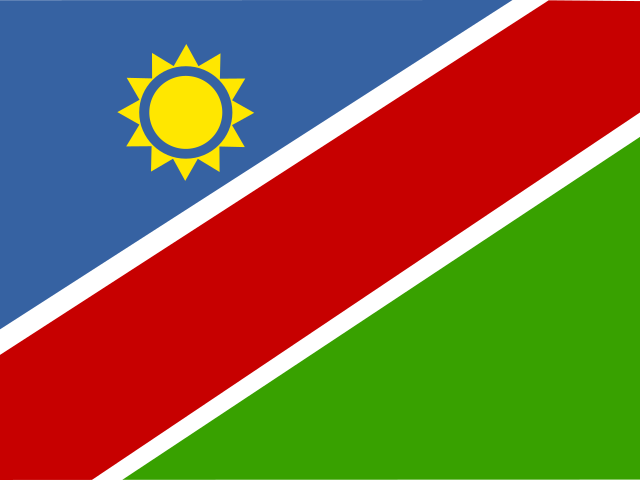
Color Names & Codes of the Namibia Flag
These are the main colors used in the national flag of Namibia. Copy any card to grab the color details in one click.
- Hex
- #3662A2
- RGB
- 54, 98, 162
- CMYK
- N.A.
- Pantone
- N.A.
- RAL
- N.A.
- Hex
- #FFFFFF
- RGB
- 255, 255, 255
- CMYK
- N.A.
- Pantone
- N.A.
- RAL
- N.A.
- Hex
- #C70000
- RGB
- 199, 0, 0
- CMYK
- N.A.
- Pantone
- N.A.
- RAL
- N.A.
- Hex
- #38A100
- RGB
- 56, 161, 0
- CMYK
- N.A.
- Pantone
- N.A.
- RAL
- N.A.
- Hex
- #FFE700
- RGB
- 255, 231, 0
- CMYK
- N.A.
- Pantone
- N.A.
- RAL
- N.A.
Download the Namibia Flag
Download the SVG master file directly, or export the same artwork as PNG, WebP, or JPEG from the page.
Namibia Flag Proportion and Design
Official ratio and design notes for the national flag of Namibia.
| Official Ratio | 2:3 |
| Layout | A diagonal red band edged in white rises from the lower hoist to the upper fly, dividing a blue upper triangle and a green lower triangle, with a gold sun in the upper hoist. |
| Main Shapes | A broad red diagonal stripe with narrow white borders, plus a gold twelve-ray sun centered inside the blue field near the hoist. |
| Construction Notes | The official description defines a blue-over-green field separated by a white-fimbriated red bend. Placing the sun in the blue canton keeps the emblem readable at distance while the diagonal band gives the whole flag a strong sense of direction and movement. |
What Does the Namibia Flag Mean?
The Namibia flag was approved by the Constituent Assembly on February 2, 1990, shortly before independence, and it entered national use when Namibia became sovereign on March 21, 1990. Official Namibian explanations present the flag as a symbol of peace, unity, and common loyalty to the country at the moment of statehood.
In that official reading, red stands for the people of Namibia and their heroism and determination to build a future of equal opportunity. White refers to peace and unity, while green is associated with vegetation and agricultural resources.
Blue is explained through the Namibian sky, the Atlantic Ocean, the country's marine resources, and the importance of rain and water. The golden sun represents life and energy. Together, the diagonal layout is often understood as giving these ideas movement, so the flag feels forward-looking rather than static.
What Is the Meaning of Colors in the Namibia Flag?
The official symbolism of the Namibia flag is unusually explicit, so the colors can be read with confidence rather than guesswork. Blue refers to sky, ocean, water, and rain; red to the people and their resolve; and green to vegetation and agricultural wealth.
White plays a structural and symbolic role at the same time. In official explanations it stands for peace and unity, and in the design it separates the red diagonal band from the blue and green fields so the central stripe remains crisp at any size.
The gold sun completes the palette by introducing life and energy into the upper hoist. Because it sits against blue rather than inside the red band, the emblem stays visually distinct and helps the whole color system read as land, water, people, and national hope in one composition.
FAQ
Common questions about the Namibia flag, its design, adoption, and practical use.