
Color Names & Codes of the Micronesia Flag
These are the core colors used in the national flag. Copy any card to grab the color details in one click.
- Hex
- #6797D6
- RGB
- 103, 151, 214
- CMYK
- N.A.
- Pantone
- N.A.
- RAL
- N.A.
- Hex
- #FFFFFF
- RGB
- 255, 255, 255
- CMYK
- N.A.
- Pantone
- N.A.
- RAL
- N.A.
Download the Micronesia Flag
Download the SVG master file directly, or export the same artwork as PNG, WebP, or JPEG from the page.
Micronesia Flag Proportion and Design
Official ratio and design notes for the national flag of Micronesia.
| Official Ratio | 10:19 |
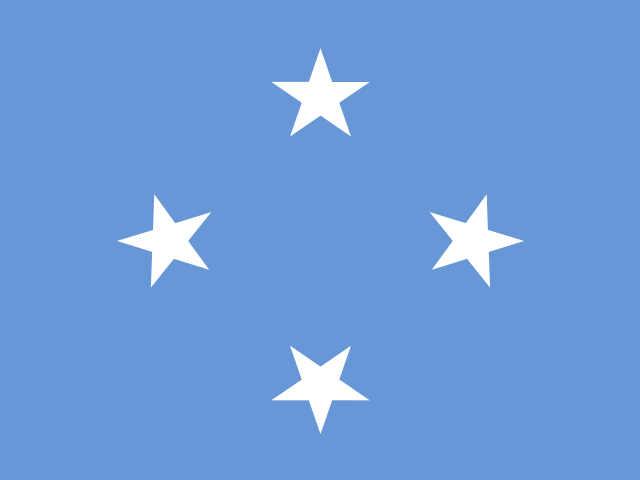
| Layout | A horizontal blue field with four white five-pointed stars centered on the flag. |
| Main Shapes | Four equal white stars form a centered circular arrangement, with one star placed above, below, left, and right of the center point. |
| Construction Notes | The official legal description specifies a circle of four white stars centered on a blue field. The width-to-length ratio is 1:1.9, and the width of the flag to the width of a star is specified as five to one, while unofficial reproductions may use other dimensions. |
What Does the Micronesia Flag Mean?
The Micronesia flag is the national flag of the Federated States of Micronesia. It was adopted on November 30, 1978, before the country entered independence-era constitutional government, and it uses a deliberately spare design: four white stars on a blue field.
The blue field is widely explained as the Pacific Ocean, the setting that links the country's many islands across a vast maritime area. The four stars represent the four states of the federation: Chuuk, Kosrae, Pohnpei, and Yap.
The stars are centered as a group rather than placed as a literal map. That gives the flag a compact emblem of federation, equality, and shared identity, while keeping the Micronesia flag simple enough to recognize from a distance.
What Is the Meaning of Colors in the Micronesia Flag?
The Micronesia flag uses only blue and white, so its color language is unusually direct. The blue field is commonly interpreted as the Pacific Ocean, which is central to the country's geography, travel, culture, and political identity as an island federation.
White is used for the four stars. Rather than carrying a long separate color code, the white stars mainly serve as clear state markers against the blue field: one for Chuuk, one for Kosrae, one for Pohnpei, and one for Yap.
Some references also connect the blue-and-white palette to the earlier Trust Territory and United Nations visual tradition in the Pacific. Because the current FSM law describes the colors and construction without assigning a detailed official symbolism for every color, that historical reading is best treated as contextual rather than as a full official color doctrine.
FAQ
Common questions about the Micronesia flag, its design, downloads, and usage.