
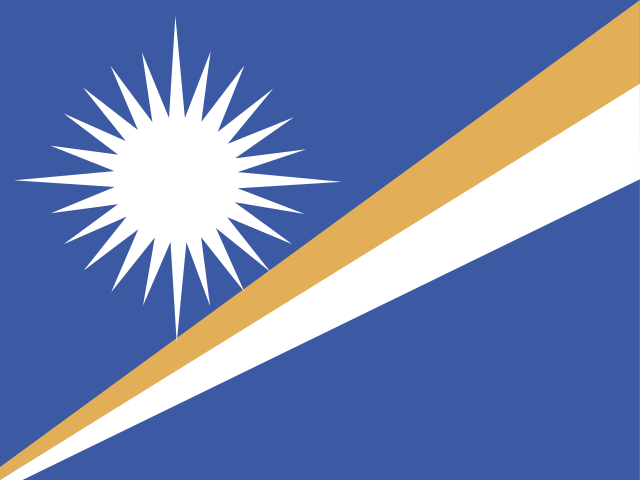
Color Names & Codes of the Marshall Islands Flag
These are the main colors used in the Marshall Islands flag. Copy any card to grab the color details in one click.
- Hex
- #3B5AA3
- RGB
- 59, 90, 163
- CMYK
- N.A.
- Pantone
- N.A.
- RAL
- N.A.
- Hex
- #E2AE57
- RGB
- 226, 174, 87
- CMYK
- N.A.
- Pantone
- N.A.
- RAL
- N.A.
- Hex
- #FFFFFF
- RGB
- 255, 255, 255
- CMYK
- N.A.
- Pantone
- N.A.
- RAL
- N.A.
Download the Marshall Islands Flag
Download the SVG master file directly, or export the same artwork as PNG, WebP, or JPEG from the page.
Marshall Islands Flag Proportion and Design
Official ratio and design notes for the national flag of the Marshall Islands.
| Official Ratio | 10:19 |
| Layout | A deep blue field crossed by two diagonal bands that rise from the lower hoist to the upper fly, with orange above white and a large white star in the upper hoist. |
| Main Shapes | Two widening diagonal bars and a 24-point white star with four longer rays. |
| Construction Notes | The diagonal bands widen as they move toward the fly, and the star is set high in the canton near the hoist. That expanding geometry gives the Marshall Islands flag a strong sense of forward motion and is widely understood as expressing growth and vitality. |
What Does the Marshall Islands Flag Mean?
The Marshall Islands flag was designed by Emlain Kabua. It was first hoisted on May 1, 1979, when the new constitutional government was introduced, and its governing legislation entered into force on June 12, 1979. That timing matters because the flag emerged alongside the country's move toward self-government rather than as a later ceremonial symbol.
The design places a white 24-point star over a blue Pacific field cut by orange and white diagonal bands. Official and reference explanations consistently connect the blue field with the ocean, while the crossing bands are commonly described as marking the nation's position in the Pacific near the Equator and giving the composition a sense of upward movement.
The star adds the clearest civic symbolism. Its 24 points are widely explained as the 24 municipalities of the republic, and the four longer rays are commonly described as highlighting the capital and three regional centers. Together, the star and rising bands make the Marshall Islands flag feel both geographic and aspirational.
What Is the Meaning of Colors in the Marshall Islands Flag?
The Marshall Islands flag relies on a small palette, so each color carries a large share of the symbolism. Blue is consistently associated with the Pacific Ocean and the country's maritime setting, which makes it the visual anchor of the whole design.
The two diagonal bands are usually read together rather than as isolated stripes. White is often associated with peace, and orange is commonly linked to courage; at the same time, the two bands help define the flag's geographic story by cutting upward across the blue field in a way that is widely explained through location, movement, and national progress.
Because the orange and white bands widen toward the fly, the colors do not sit still. They create a sense of expansion, and the contrast against the blue field helps the star stand out immediately. The result is a palette that feels simple at first glance but carries a strong message of place, confidence, and direction.
FAQ
Common questions about the Marshall Islands flag, its design, symbolism, and history.