
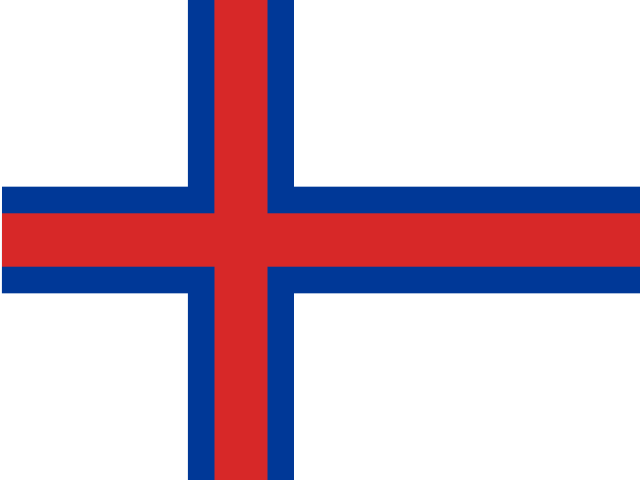
Color Names & Codes of the Faroe Islands Flag
These are the three core colors used in the Faroe Islands flag. Copy any card to grab the color details in one click.
- Hex
- #FFFFFF
- RGB
- 255, 255, 255
- CMYK
- N.A.
- Pantone
- N.A.
- RAL
- N.A.
- Hex
- #003897
- RGB
- 0, 56, 151
- CMYK
- N.A.
- Pantone
- N.A.
- RAL
- N.A.
- Hex
- #D72828
- RGB
- 215, 40, 40
- CMYK
- N.A.
- Pantone
- N.A.
- RAL
- N.A.
Download the Faroe Islands Flag
Download the SVG master file directly, or export the same artwork as PNG, WebP, or JPEG from the page.
Faroe Islands Flag Proportion and Design
Official ratio and design notes for the national flag of the Faroe Islands.
| Official Ratio | 8:11 |
| Layout | A white field with a red Nordic cross outlined in blue, shifted toward the hoist in the standard Scandinavian pattern. |
| Main Shapes | One broad white field, one red cross, and blue fimbriation that frames the cross on every side. |
| Construction Notes | Faroese flag law defines the red cross as one eighth of the flag's height and the blue edging as half that width. Public guidance also publishes the construction sequence 6:1:2:1:12 horizontally and 6:1:2:1:6 vertically, which gives the flag its balanced Nordic-cross geometry. |
What Does the Faroe Islands Flag Mean?
The Faroe Islands flag, known as Merkið, was designed in 1919 by Jens Oliver Lisberg together with other Faroese students in Copenhagen. It was first raised in Fámjin on June 22, 1919, then officially recognized by the British government for Faroese vessels on April 25, 1940. The Home Rule Act of March 23, 1948 later acknowledged a special Faroese flag in law, which gives the design both a political and historical weight.
In form, the Faroe Islands flag follows the Nordic cross tradition. Visit Faroe Islands describes the offset cross as representing Christianity, while the overall layout also places the flag clearly within the family of Scandinavian and North Atlantic symbols.
That combination of history and structure is what makes the Faroe Islands flag distinctive. Merkið is not just a regional emblem; it is tied to self-expression, maritime identity, and the period when Faroese ships needed a flag that could stand apart from occupied Denmark.
What Is the Meaning of Colors in the Faroe Islands Flag?
Public Nordic references commonly explain the white field of the Faroe Islands flag as a sign of bright sky and waves breaking on the shore. That reading fits the islands' maritime setting and helps explain why the design feels open and luminous even though it uses a simple three-color palette.
The red and blue are often connected to traditional Faroese dress, especially the colors found in the old Faroese scarf. The same explanations also link those colors to the Faroe Islands' ties with Iceland and Norway, whose flags share related red, white, and blue combinations.
Because these symbolic readings come from public explanatory sources rather than the flag law itself, they are best understood as widely used interpretations. Even so, they show why the palette works so well: the colors connect local culture, Nordic affiliation, and the sea-bound landscape in one compact design.
FAQ
Common questions about the Faroe Islands flag, its name, recognition, downloads, and practical use.