
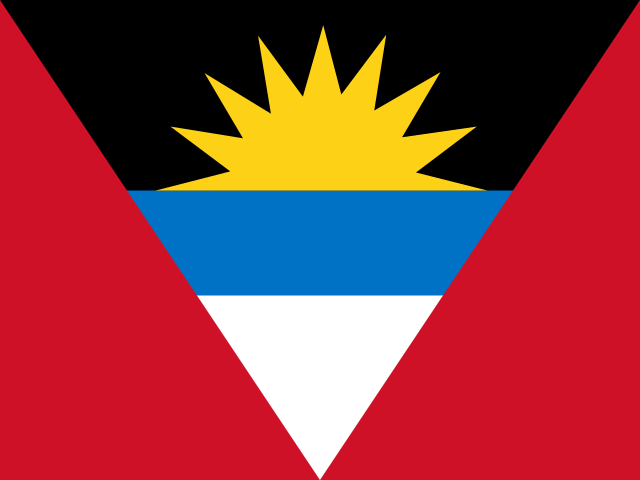
Color Names & Codes of the Antigua & Barbuda Flag
These are the core colors used in the national flag. Copy any card to grab the color details in one click.
- Hex
- #000001
- RGB
- 0, 0, 1
- CMYK
- N.A.
- Pantone
- N.A.
- RAL
- N.A.
- Hex
- #0072C6
- RGB
- 0, 114, 198
- CMYK
- N.A.
- Pantone
- N.A.
- RAL
- N.A.
- Hex
- #CE1126
- RGB
- 206, 17, 38
- CMYK
- N.A.
- Pantone
- N.A.
- RAL
- N.A.
- Hex
- #FCD116
- RGB
- 252, 209, 22
- CMYK
- N.A.
- Pantone
- N.A.
- RAL
- N.A.
- Hex
- #FFFFFF
- RGB
- 255, 255, 255
- CMYK
- N.A.
- Pantone
- N.A.
- RAL
- N.A.
Download the Antigua & Barbuda Flag
Download the SVG master file directly, or export the same artwork as PNG, WebP, or JPEG from the page.
Antigua & Barbuda Flag Proportion and Design
Official ratio and design notes for the national flag of Antigua & Barbuda.
| Official Ratio | 2:3 |
| Layout | A horizontal rectangle with red triangular side panels, a black upper band, a central blue band, and a white inverted triangle rising from the bottom edge. |
| Main Shapes | A rising golden sun centered on the black field, a blue horizontal strip beneath it, a white chevron, and red side panels framing the central composition. |
| Construction Notes | The design is built around a centered sunrise motif above a layered V-shaped composition. The black, gold, blue, and white elements read from top to bottom inside a red frame, creating a strong upward movement that makes the flag instantly recognizable. |
What Does the Antigua & Barbuda Flag Mean?
The Antigua & Barbuda flag was designed by Reginald Samuel and adopted on February 27, 1967, when the territory became an associated state with internal self-government. That historical moment matters because the flag was created to mark political change, not just to provide a decorative national emblem.
Its central image is the rising golden sun above black, blue, and white bands. On the official government explanation, the sun stands for the dawn of a new era, while the overall upward movement gives the design a strong feeling of emergence, confidence, and national momentum.
The composition also carries a second layer of meaning. The V-shaped form is commonly read as a sign of victory, and the sequence of gold, blue, and white is often explained as sun, sea, and sand. Together, those elements make the flag both symbolic and highly distinctive among Caribbean flags.
What Is the Meaning of Colors in the Antigua & Barbuda Flag?
The official symbolism of the Antigua & Barbuda flag gives each color a specific role. Black is associated with African heritage and the soil, blue with hope, and red with the lifeblood of forebears and the energy of the people.
Gold, blue, and white are also read together rather than separately. In that sequence, they are commonly explained as sun, sea, and sand, which ties the flag directly to Antigua and Barbuda's Caribbean setting. This makes the color system more than decorative: it links national identity, geography, and historical memory in a single design.
Because the colors are arranged inside a rising V-shaped composition, they do not feel static on the page. The palette works as a narrative device, moving the eye upward from white to blue to the sun and reinforcing the idea of optimism, place, and forward movement.
FAQ
Common questions about the Antigua & Barbuda flag, its design, symbolism, and historical background.